

How to Run a Freight RFP When Rates Change Every Week


The freight rate you agreed for a lane last month has probably moved already. Across the ocean freight quotes we analysed from January to September 2026, the average rate for the same container on the same lane shifted by a median 17.5% from one month to the next. Nearly half the moves were bigger than 20%. Some happen inside a week: in June, Drewry’s index had Shanghai to Rotterdam up 15% in a single week.
On volatile lanes, an annual price often stops matching the market long before the contract ends. So shippers re-price mid-term, and the RFP has to keep up. In our conversations with shippers about freight tenders, 39% still run them on email and Excel, and one said a quarterly re-bid “takes five to 10 days” just to gather, compare and renegotiate.
This guide shows how to run a freight RFP you can re-run whenever the market moves: what to prepare, how to collect and compare bids, how to award, and which steps to hand to software so the team only makes the decisions.
What is a freight RFP?
A freight RFP (request for proposal) is a structured request to carriers or freight forwarders to bid on your lanes. It sets out your lanes, volumes and service needs, collects comparable bids, and ends in contract rates with service and capacity terms for a set period.
A carrier RFP goes straight to shipping lines, airlines or trucking companies and suits stable, high-volume lanes. A freight forwarding RFP goes to forwarders and suits door-to-door moves, several origins and volume that varies. Many shippers run both.
What has changed is how often the RFP runs. It used to be a once-a-year event, built from scratch each autumn. When quotes move by double digits in a month, it has to be something you can run again next quarter without rebuilding it.
What is the difference between a freight RFP and an RFQ?
An RFQ (request for quotation) asks for a price, usually for one shipment or a short period. An RFP asks for price plus service, capacity and contract terms, and it ends in a contract. Use an RFQ for spot and irregular lanes, and an RFP for stable lanes where service matters as much as the rate.
The two sit in a wider set of bidding events:
| Event | What you ask for | Use it for |
| RFI (request for information) | What bidders can do, where they operate, their licences | New lanes or regions where you don’t know who can serve |
| RFQ | A price for one shipment or a short period | Spot moves, irregular lanes, small volumes |
| RFP | Rates plus service, capacity and terms for a contract | Stable, high-volume lanes |
| Reverse auction | Lower bids in timed rounds; bidders see only their rank | Clearly defined lanes where price is the main lever |
| Mini-bid | A re-bid on a few lanes during a contract | Lanes where the market or a carrier’s service has moved |
What trends are shaping freight RFPs in 2026?
As of October 2026, four shifts are changing how shippers run freight RFPs: spot rates that move week to week, contracts amended mid-term, re-pricing written into some contracts, and more freight moving between contract and spot.
The swings haven’t settled. Shanghai to Rotterdam stood at $3,632 per 40ft on 22 October, about 16% below its June level.
What are shippers doing about it? In US ocean shipping, they are amending contracts more and signing fewer new ones. The Federal Maritime Commission logged 996,803 amendments to service contracts in fiscal 2025, up 148,000 on the year, while original contracts fell by about 2,000. The FMC’s reading is that shippers “relied more heavily on amending existing contracts and redirected some volume to the spot market.”
Some shippers are writing re-pricing into the contract itself, and advisers recommend it:
- SHIFTX, a cooperative of small and mid-sized shippers that negotiate with carriers collectively, has described a clause allowing “re-entry into negotiations with the carriers if there was an underlying huge drop in the rates,” The Loadstar reported in May.
- Drewry recommends contract language that lets shippers “trigger a rate review if market prices collapse”.
Contracted capacity is less certain too. In US trucking, carriers accepted around 85% of contracted loads on the first offer in early 2026, down from around 92% a year earlier, Uber Freight reported in March, and the market is pushing shippers toward “more flexible contract-plus-spot strategies.” At sea, global schedule reliability fell to 49.9% in August, according to Sea-Intelligence.
Buyers describe the same shift from the inside. One pharma shipper buying direct from carriers said its rates went from three- or four-month contracts before Covid to per-vessel pricing, and now to month by month, with two of its carriers quoting monthly too.
Which lanes need an annual contract, a mini-bid or spot?
One chemicals shipper we spoke to works this way: its major lanes run on contracts, mostly monthly, and its small lanes stay on spot. That’s a split by how stable the volume is and how hard the rate swings, and it’s a simple way for any shipper to decide which event each lane needs:
- Stable, high-volume lanes: an annual contract, with a clause that reopens the rate if the market moves past a set point.
- Volatile lanes: a quarterly contract, or scheduled mini-bids.
- Irregular lanes and the long tail: spot RFQs.
Which bucket each lane goes in is your team’s call. What has changed is how you find the lanes that need a second look. Instead of someone pulling a quarter’s quotes into a spreadsheet, GoComet’s Nova keeps an eye on each lane’s history against the thresholds you’ve set and points out the quotes and awards that need attention. The review starts with the lanes that moved.
How do I prepare a freight RFP?
To prepare a freight RFP, set the scope and award rules, build a lane sheet, fix one bid format with every charge listed, write your service and contract terms, then publish the scoring rules and timeline. Save all of it. Next time, you only update the lanes and volumes instead of building the RFP from scratch.
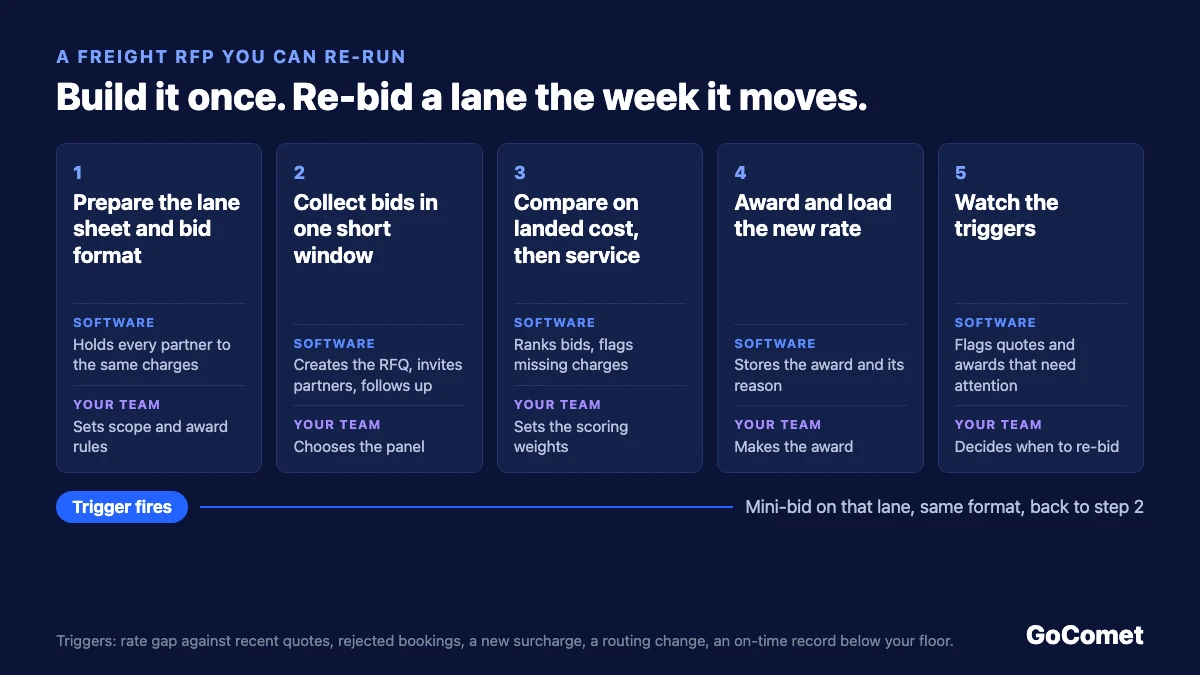
Most of that is standard. Where freight RFPs go wrong is in five details that decide whether the quotes can be compared at all, and whether the awarded rate survives the contract.
1. In the lane sheet, separate what’s firm from what’s a guess. One row per lane, sorted by spend: origin and destination, Incoterm, equipment, commodity, any dangerous-goods or reefer needs, and the longest transit you’ll accept. Give volume as a range and mark each lane committed or indicative. Bidders then know which volume they can count on and which might never ship. Gathering lane history and forecasts is a sticking point for 35% of the shippers in our talks about tenders, so start from what you actually shipped last period, not last year’s forecast.
2. Leave no blanks and no “as applicable” in the charge list. More than a third (37%) say their quotes won’t line up. A manufacturer put its finger on why: bidders leave four or five items “as applicable”, and that is exactly where the difference between them hides. So every bidder prices the same list of charges: a zero is fine, a blank isn’t, and anything billed at cost carries a cap or an estimate. Before you send it, test the format on yourself: could you add up every bid to one number per container without phoning anyone? If not, it isn’t finished.
3. Set validity by how fast your lanes move. In the quotes we analysed for 2026, rates on a lane moved more than 10% in three months out of four. So a quote from week one and a quote from week five may not be comparable. Collect all bids in one short window, make sure they stay valid until you award, and ask bidders to confirm their price again if the award is delayed.
4. Write free time the way it will be billed. For each end of the lane, state the free days, whether demurrage and detention are separate or combined, when the clock starts, and whether days are counted as working or calendar days. Loose wording costs money later. An importer learned this the hard way: they had agreed to seven days of demurrage and seven of detention, and on arrival found it had “only five days combined.”
5. Price the surcharges you can already see coming. Say which surcharges are included, which index each follows, and how much notice a bidder must give before adding a new one. Some increases are already scheduled. Under the EU Emissions Trading System, shipping companies surrender allowances for 70% of their 2025 emissions this year and 100% from 2027, according to the European Commission, and carriers pass that cost on as ETS fees. A contract signed now for lanes touching Europe runs straight into that step, so agree how the fee is calculated before it changes. Add a clause that reopens the rate if the market moves past a set point.
What you ask bidders for also changes by mode. Here’s what to set for each:
| Ocean | Air | Road | |
| Lane | Port pair | Airport pair | Origin and destination, by postcode or city |
| Volume | Containers by type | Chargeable kg | Loads or pallets |
| Price | Base freight plus each surcharge, marked included or priced | Rate per kg by weight break, plus fuel and security | Rate per load or per km, plus fuel |
| Terms that cost money later | Free days for demurrage and detention | Fuel surcharge formula and how often it resets | Waiting time and accessorials |
A fixed format pays off as soon as the quotes come in.
Did you know? When the RFQ in GoComet carries the lane, equipment, service terms and required charges, every forwarder prices that same requirement, and the quotes arrive ready to compare.
How to collect bids without the email chase
Collecting bids is where an RFP loses most of its time. The shipper sends a spreadsheet, chases the replies, and re-keys each quote into a comparison, often over several rounds. Run that way, re-bidding a lane the week it moves is out of reach.
Send one package: the lane sheet, the bid format, the contract terms and the scoring rules, with one window for questions (every answer shared with every bidder) and one deadline. Invite only bidders you’d award. Panels are often smaller than buyers want: one pharma shipper said it asked only three or four forwarders, “a limitation on manpower,” not a choice.
How many rounds? Fewer than most buyers run. Unlimited rounds teach bidders to trim a dollar or two each time. One automotive buyer sets a fixed number, “five chances,” with a real improvement expected in each, “otherwise everything is closed.”
The sending and the chasing are the parts to hand over first. Ask Nova for pricing on a set of lanes and it creates the RFQ, invites your approved forwarders and opens the bidding, while AI Workers follow up on the open work before your team has to. With that off the team’s desk, the panel can be sized to the lane instead of to the team’s spare hours. Forwarders still expect an email invitation, and several buyers find that notices posted only on a portal get ignored, so the invitation should reach them where they already work.
How do you evaluate freight bids beyond price?
When you re-bid every quarter or month, evaluation has to be fast and the same every time. Do it in two passes. First, turn every bid into landed cost per container or per chargeable kg, in one currency. Then score each bid on reliability, transit, capacity, free time and invoicing, with weights you set once, before the first round, and keep for every re-bid, so this round’s award can be compared with the last.
Price alone hides too much. In August, Maersk ran at 67.3% schedule reliability and Wan Hai at 23.2%, the top and bottom of the 13 largest carriers. Check transit times too: an electronics shipper was once quoted 20 days on a lane where vessels usually take 40. And the cheapest carrier on every lane isn’t always the best award. “I cannot work with 20 or 30 companies just to have the best price for each lane,” as a car-industry buyer put it.
GoComet does the arithmetic: all-in landed cost for each quote, every currency on one basis, bids ranked with rates, transit and validity side by side, and missing charges flagged. Your team sets the weights and makes the call. When the winner isn’t the lowest bid, the reason is stored with the award, ready for finance or an auditor.
How to award lanes so the rate holds
An award only holds if it’s the rate your team books against, with a backup when the first choice says no. And every time a lane is re-bid, there’s a new rate to put to work.
- Name a backup for every lane. Some shippers rank three deep. One bids quarterly and nominates a first, second and third forwarder per lane; if the first can’t take a booking, the volume moves down the list.
- Plan for refusals. In US trucking, about 15% of contracted loads were turned down on the first offer in early 2026.
- Then load the new award before the next booking goes out: the rates, the free time and the backup carriers. Miss that step and the team keeps booking at last round’s rate.
- The invoice is where that shows up. Off-contract bookings and invoices nobody checks against the award trouble 16% of the shippers in our conversations. “I cannot monitor,” said one, about the 14 days of free time it had won in a tender. So check each invoice against the latest award, not the contract you signed a year ago. That line-by-line check is work GoComet’s invoice reconciliation takes on, so a missed free day or a rate that slipped shows up before the invoice is paid.
When to re-bid: set the triggers before you sign
Decide in advance what sends a lane back out to bid, and write it down before the contract is signed:
- the contract rate stays above your recent quotes on the lane for several weeks, by a gap you set
- the awarded carrier or forwarder rejects or rolls bookings repeatedly
- a new surcharge lands on the lane
- the routing changes
- the carrier’s on-time record on the lane drops below your floor
When a trigger fires, run a mini-bid on that lane only, in the same format as the main RFP. The lane sheet, the charge list and the scoring weights stay the same; only the lanes change. Nova checks quotes and awards against the thresholds you set, so the ones that cross them come forward without anyone searching, and the team decides whether to re-bid.
Which RFP steps to hand to software and AI, and which to keep
Hand over the steps that are repetitive and rule-bound, and keep the ones that need judgement or a relationship.
| Step | Software and AI | Your team |
| Preparing | Holds every partner to the same requirement and required charges | Sets scope, award rules and which lanes go out |
| Inviting | Creates the RFQ, invites approved partners and follows up | Chooses the panel |
| Comparing | Works out landed cost, ranks bids, flags missing charges | Sets the scoring weights |
| Awarding | Stores the decision and the reason with the award | Makes the award and owns the reason |
| After the award | Checks billed charges against the contract; brings forward quotes and awards that need attention | Decides when to re-bid and handles the carrier relationship |
Once the sending, chasing and comparing no longer sit with the team, re-bidding a lane the week it moves becomes something it can actually run, and the award stays with the people accountable for it.
When an annual RFP still works
On stable lanes with long-term partners, an annual contract with a re-pricing clause is still the right tool. Re-bidding is also not the same as playing carriers off against each other. One buyer warned that using one carrier’s quote to bid down another is “completely unprofessional”: the carrier honours the rate, then comes back with “sorry, no equipment, sorry, no capacity.”
Price can also be the deciding factor on simple, clearly defined lanes, where every bid buys the same service. Some buyers have no choice: one chemicals shipper’s auditor won’t accept an award that isn’t the lowest bid, even with a written reason.
So the aim isn’t to re-bid everything all the time. It’s to be able to re-bid any lane quickly when the market or the service on it moves.
Build the RFP once
The market will keep moving. Shanghai to Rotterdam moved 15% in one week this June, and the next swing will hit lanes on contracts signed months earlier. Build the lane sheet, the bid format and the triggers once, and each re-bid after that is a much smaller job.
GoComet runs the freight RFP as a repeatable process: one structured RFQ to your approved partners, quotes ranked on all-in landed cost, and the award and its reason kept together. Your team makes the decisions; the sending, chasing and comparing move to software.
If you’d like to see how that works on your own lanes, bring one of your RFQs to a GoComet demo.
FAQ
How often should you run a freight RFP?
It depends on the lane. Stable, high-volume lanes can run on an annual contract with a re-pricing clause; volatile lanes need quarterly contracts or mini-bids; irregular lanes stay on spot. Set triggers that send a lane back out between rounds.
How long does a freight RFP take?
A full RFP takes weeks when it is run by email and Excel, and buyers told us even a quarterly re-bid can take five to 10 days. With a reusable lane sheet and bid format, and software doing the sending and comparing, a mini-bid on a few lanes is a much smaller job.
How much does a freight RFP cost to run?
Mostly team time: building the package, chasing bidders, comparing quotes and loading the awarded rates. The bigger cost is a poor award, such as a rate that doesn’t hold or a carrier that refuses the bookings.
Is there a free freight RFP template?
Yes. Our [freight RFP template] is an Excel workbook covering lanes for ocean, air and road, the bid format, pre-qualification, scoring and award.
What should a freight RFP proposal include?
A lane sheet with volumes, a fixed bid format with every charge, free time, validity and surcharge rules, your service requirements, and the scoring method. Bidders return rates in that format, with transit, routing and capacity.