Demurrage and Detention Charges and How to Avoid Them


In 2026, 62% of the demurrage and detention invoices we analysed for companies whose accounts run in US dollars came on their own, with no freight charge on them. The freight bill gets checked against the contract. A D&D bill on its own has no freight line beside it to check against.
And the free days on that bill may not be the ones you agreed:
- One importer had seven days of demurrage and seven of detention in its deal with the carrier, and on arrival got “only five days combined”.
- Another had 21 free days in its contract, booked one shipment on spot, and said: “we are not getting this 21 days”.
This guide covers demurrage vs detention for US importers and exporters: what each charge is, where your free days come from, what a day costs, how to dispute a bill, and how to stop the charges before they start, with what software now does at each step.
What is the difference between demurrage and detention?
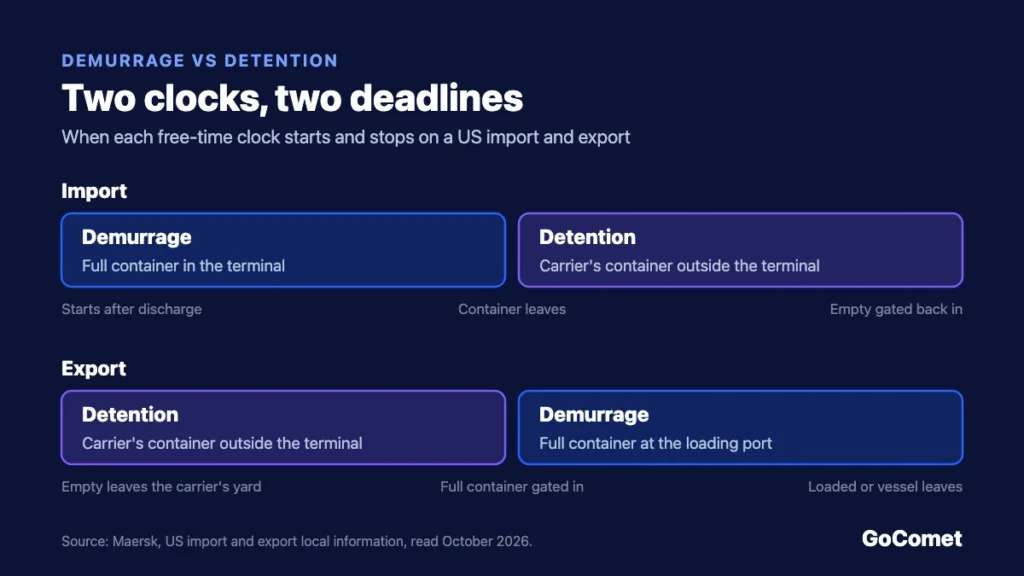
Demurrage is charged while a full container stays in the terminal after its free days run out. Detention is charged while the carrier’s container is outside the terminal past its free days. They usually have separate free days, though some carriers sell one shared pool for both. Even then they are two deadlines: one to get the container out of the terminal, one to get the empty back.
On a US import, Maersk’s terms set the two clocks like this:
- Demurrage free time starts at 8:00 am on the first business day after discharge, and ends when the full container leaves the terminal.
- Detention free time starts on the day the container leaves the carrier’s yard, and ends on the day the empty is gated back in.
On a US export, the order flips:
- Detention runs from empty pickup until the full container is gated in at the terminal.
- Demurrage runs from its arrival at the loading port until it is loaded or the vessel leaves.
“Per diem” on a US invoice belongs to the same family. The Federal Maritime Commission (FMC) counts “any charges, including ‘per diem'” for the use of terminal space or containers as demurrage and detention (46 CFR 545.5).
Where do your free days actually come from?
Free days come from the terms of each booking: your service contract, the carrier’s tariff, a spot booking’s terms, or the seller’s booking if the seller arranged the freight. So the number in your contract is not always the number on the container. There are three common ways it changes.
1. A spot booking replaces the contract
Maersk’s spot terms say their demurrage, detention and free-time terms “shall replace and supersede any separately agreed” rates (section 4.1). On FMC-regulated lanes a Schedule 1 to those terms takes precedence in a conflict, but we found nothing in it that brings contract free days back. The importer with 21 days ran into the same split: its contract said 21, and its spot booking didn’t.
2. The seller booked the freight
Under the Incoterms CFR and CIF rules, the seller books and pays for the main carriage. The container then travels on the seller’s terms, which the buyer may never see. As a CIF importer put it: “We don’t have the service contract on our end”.
3. Separate days become one combined pool
Maersk offers detention, demurrage or combined free time as alternatives, set by country. “14 days free demurrage and detention combined” means one pool shared by both charges, so every day at the terminal comes out of the days you have to return the empty.
In our conversations with shippers about D&D between October 2024 and October 2026, about 18% raised where their free days come from; often the agreed days sat in emails, quotes and paper contracts rather than on the bill of lading. So check each container before it sails:
- Is this a contract booking or a spot booking?
- Did you book it, or did the seller (CFR or CIF)? If the seller, ask for its free-time terms.
- Is there a negotiated number for this lane, or does the carrier’s published tariff apply?
- Are demurrage and detention separate, or one combined pool?
- Are days counted as working days or calendar days, and what starts the clock at this port?
Keeping five answers straight for every container falls apart at a few hundred containers. With GoComet’s container tracking set up on your own free-day terms, each container runs against the days you’ve entered, and the team gets an alert as it nears the limit.
How many free days do you get, and how are they counted?
Maersk’s 2026 US import tariff gives four free days of detention on a dry container. Demurrage free time is set port by port. On top of that, the count itself changes by carrier and port:
- Start time. At Los Angeles, Maersk’s demurrage free time begins at the “first 3:00 AM following container discharge”; at Jacksonville, at the “First 7:00 AM following vessel departure”.
- Which days count. Only days the gate is open. A terminal that closes for part of a day still uses up a full free day.
- Working vs calendar days. Some carriers, such as ARL on the US East Coast, count free days as working days, then bill every calendar day once they run out.
- Routing. Some shippers have seen carriers count from discharge at the transshipment port instead of the final port, or start the clock at an inland depot on a through bill of lading.
How much do demurrage and detention cost per day?
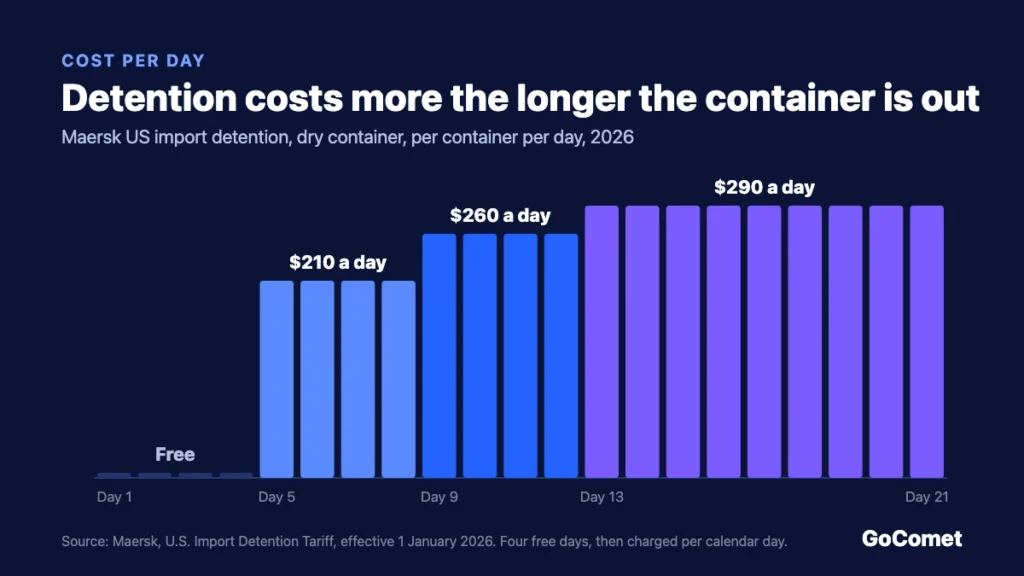
Once free time ends, carriers charge per container per day, in tiers that rise the longer it stays. Maersk’s 2026 US import detention for a dry container:
| Days | Rate per day |
| 1–4 | Free |
| 5–8 | $210 |
| 9–12 | $260 |
| 13+ | $290 |
Maersk’s US demurrage starts at about $300 a day at its default ports. The first chargeable days at one port can also cost very different amounts by carrier. At Port Everglades:
- Maersk’s demurrage runs $360 a day for days 5 to 8.
- MSC’s published US tariff lists $110 a day for its first period on a 40ft dry container, then $220 (effective 1 August 2026).
The tiers are what make lost free days expensive. Take a dry container that should have had 21 free days under its contract but gets Maersk’s standard four. Returned on day 21, it pays detention for days 5 to 21: $4,490 on one container (our arithmetic on the published tariff).
Tiered tariffs are tedious to work out by hand, so teams approximate; one estimates every container “with a flat 15-day calculation”, which is wrong for every container that stays less or more than 15 days. Software can’t make the tariff simpler, but it can stop the count running unnoticed: tracking raises an alert as each container nears its free-day limit, before the first tier starts.
Why do charges start before anyone sees them?
Three things use up free time before anyone looks at a bill.
1. Late ships and slow ports
Global schedule reliability fell to 49.9% in August 2026, the lowest since September 2022, and late vessels averaged 6.81 days late, according to Sea-Intelligence. At Los Angeles and Long Beach, containers waiting for rail sat 6.75 days on average in August, up from 6.34 in July (FreightWaves, from Pacific Merchant Shipping Association data).
2. Holds
Customs exams, missing documents, payment disputes and carrier credit holds all keep a container in the terminal while its days run. Maersk warns that a missing proof of payment “will delay cargo delivery and additional demurrage charges to accrue”.
3. Bills that arrive late
A carrier can invoice up to 30 calendar days after the charge was last incurred (46 CFR 541.7), so the decision behind it can be a month old by the time anyone sees the cost. Knowing before charges build up was the most common ask in our D&D conversations, from about 38% of shippers. One container sat at a port for more than four months, and “the shipping line never flagged it”.
Watching hundreds of containers on carrier websites is the part software takes off the team. Container tracking follows each container’s free-day timeline and raises an alert as it approaches demurrage or detention, early enough to clear a hold, book a truck or return the empty.
When paying demurrage is the cheaper choice
Some importers leave containers at the terminal on purpose, because moving them costs more. “Many instances it is deliberate,” one US company said; when the other option has “bigger cost impact,” it asks the carrier to hold the container. For others D&D is small: they negotiated long or combined free days, their customs clears on time, or the seller pays.
With a full warehouse, a few days of demurrage can be the cheaper cost. What’s worth stopping is the charge nobody chose, like the spot booking that swapped out the contract’s free days.
Can you dispute demurrage and detention charges?
Yes. On US trades, a demurrage or detention invoice must list set details, including the free time, its start and end dates, the rate and the rule it comes from. If any are missing, you are not required to pay it. You get at least 30 days to ask for a waiver or refund, and in a charge complaint the carrier has to prove the charge is reasonable.
Your rights, in order:
- The invoice must show the details. Under the FMC’s rule, 46 CFR 541.6, that means the bill of lading and container numbers; the allowed free time with its start and end dates; the container availability date (imports) or earliest return date (exports); the dates charged; the rates and the tariff or contract rule behind them; and a contact for disputes.
- A missing item cancels the charge. Leave one out and the rule “eliminates any obligation of the billed party to pay” (541.5).
- You get time to dispute. At least 30 calendar days from the invoice date to request a refund or waiver, and the carrier must try to resolve it within 30 days (541.8).
- The carrier has to prove it. Under the US shipping law (OSRA), a carrier facing a charge complaint has to show its charge is reasonable. The FMC’s Charge Complaint Procedures rule, effective 1 September 2026, confirms that complaints can also go through the formal complaint and small-claims routes, with the carrier bearing “the burden of establishing the reasonableness” of the charge.
Two 2026 cases show how this plays out:
- In April, a federal appeals court upheld the FMC’s finding that $510 of detention billed to a trucker for days when the Port of Savannah was closed was unreasonable (Evergreen v. FMC).
- In January, the FMC assessed $22.67 million in penalties against MSC, including $13.1 million for overcharging D&D on non-operating refrigerated containers.
Checking a bill against that list by hand means digging out the bill of lading, the movement dates and the free days for every container. GoComet’s invoice reconciliation software uses the shipment, movement and free-time records already in the system to help your team review D&D charges against the applicable terms, and keeps the billed charge, the terms and the evidence together for a dispute. Your team decides what to challenge.
Who pays demurrage and detention?
Usually the shipper or the consignee, whoever the tariff or contract names.
- Maersk’s US terms charge detention to the shipper or consignee, and if another party is invoiced on their behalf, “The Shipper or Consignee shall remain responsible for all charges due”.
- The FMC rule that set out who could properly be billed was struck down by a federal appeals court in WSC v. FMC and removed effective 29 December 2025.
- Billing the wrong party can still cost a carrier: $65,000 of the MSC penalty was for billing D&D to customs agents listed only as notify parties.
How to stop demurrage and detention before they start
Each charge has its own deadline, so the work splits by stage.
| Step | What to check | What software takes on |
| 1. Before the container sails | Contract or spot; who booked; separate or combined days; on CFR or CIF, the seller’s free-time terms | Tracks each container against the free-day terms you set |
| 2. Before arrival | Release documents and proof of payment submitted; customs and carrier holds cleared | Tracks each container’s movement and free-day timeline |
| 3. On arrival | Terminal last free day; truck and chassis booked; with containers on different carriers’ tariffs and too few trucks, the highest daily rate collected first | Alerts as each container nears demurrage |
| 4. After pickup | Empty return booked; the gate-in date kept as evidence | Alerts as each container nears detention; keeps its movement dates |
| 5. When the bill arrives | Every item 46 CFR 541.6 requires; free days and dates match yours; disputed within the window (at least 30 days from the invoice date) | Helps review D&D charges against the applicable terms and keeps the evidence for a dispute |
Two steps catch the most:
- The check before sailing finds the free days that were never yours, while you can still change the booking or ask the seller.
- The check when the bill arrives turns an invoice you would have paid into one you may not owe.
Where D&D management is heading
The bill now carries what you need to check it. Since 2024, a US D&D invoice has to state its free days, dates, rule and rate, so it can be compared line by line with the container’s own record instead of argued over by email. The regulator is still active: in October 2026, the FMC ordered COSCO to show cause over a $24,328.80 D&D award paid 223 days late, and it has said it may come back to who can be billed.
Late arrivals were using up free time the importer never controlled in August 2026, with schedule reliability at 49.9%. Software set up on your free-day terms can now watch every container and flag the ones running low, which leaves people to decide which to pick up, which to hold and which bills to challenge.
See it on your own containers
If your team still learns about demurrage and detention from the invoice, it’s worth seeing what the same work looks like when software watches every container’s free days and helps check each bill against your terms. See how GoComet tracks free time.
Frequently asked questions
What is the difference between demurrage and storage charges?
Demurrage is the carrier’s charge for a full container left in the terminal past its free time. Storage is the terminal’s or rail ramp’s charge for its land; at some US rail ramps, Maersk lets storage be paid to the facility directly and charges demurrage for its equipment only.
Is per diem the same as detention?
The FMC counts per diem as part of demurrage and detention: any charge for the use of terminal space or containers, other than freight.
Can demurrage and detention be charged on the same container?
Yes, one after the other on an import: demurrage until the full container leaves the terminal, then detention until the empty is returned. Under a combined allowance, both draw on one set of free days.
What does “14 days free detention at destination” mean?
The container can be outside the terminal for 14 days, from pickup to the empty’s return, before detention starts.
How are demurrage and detention different on exports?
Detention runs from when the empty leaves the carrier’s yard until the full container is gated in at the terminal. Demurrage runs from its arrival at the loading port until it is loaded or the vessel leaves.